

4.9
+4.2K avisFree running and trail calculators
All Campus calculators are free and designed by our coaches. Find your bearings to train and achieve your next goal.
Our coaches’ expertise at your service
600,000 runners have already improved their performance using the Campus method. A proven training philosophy, refined through the analysis of 60 million kilometres of running.


Mathieu Blanchard
Winner of the Yukon Arctic Ultra in 2025, 2nd at the Hardrock 100 in 2025, winner of La Diagonale des Fous in 2024, winner of the MaXi-Race in 2024, 2nd at the UTMB Mont Blanc in 2022.
"In my opinion, everyone, at their own level, should allow themselves adventures."


Nicolas aka Running Addict
2h33 at the Valencia Marathon 2023, qualified for the Ironman 70.3 World Championship 2019, MaXi-Race 60 km finisher
"When you run, you prove to yourself that with willpower and perseverance, you can move mountains."
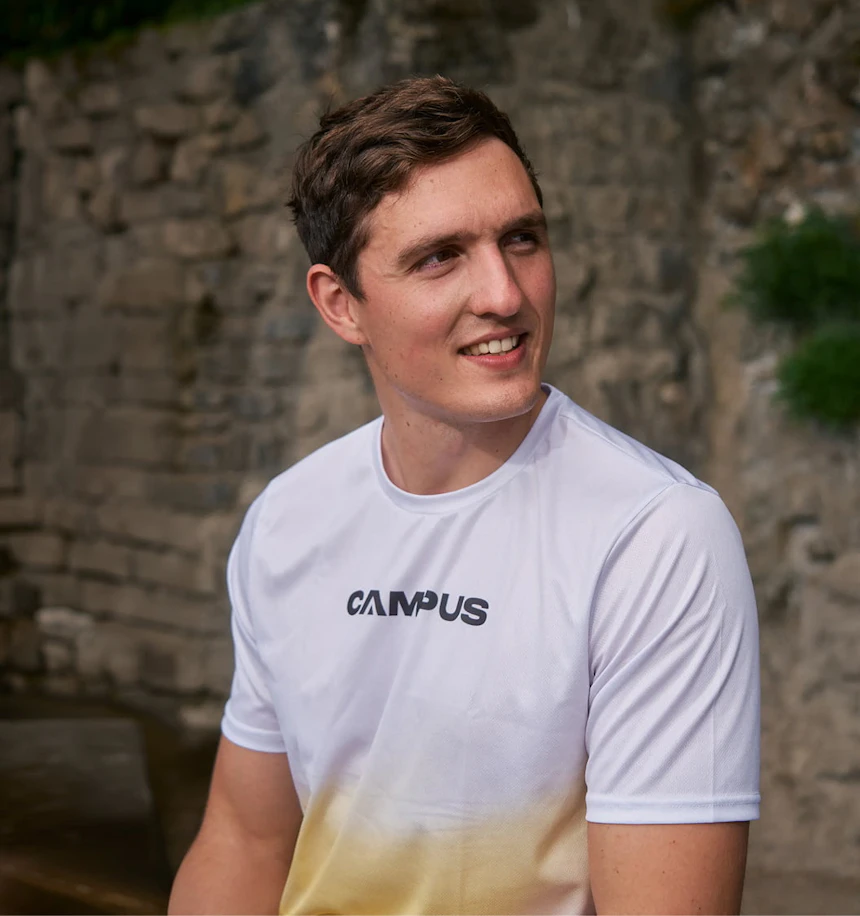

Tristan aka IRONUMAN
Qualification for Ironman Worlds 2023, finisher of the 7 Majors, finisher of the Norseman (black tee-shirt).
"A feeling of freedom acquired through the discipline of regular training. Quite a paradox (or maybe not so much)."

Start your free trial


4.8
+3.2K avisThey went all the way with Campus
 4.9+4.2K avis
 4.8+3.2K avis
 4.5+1.5K avis
Ludivine
Very well made, this application allows you to prepare any running or trail goal... It is easy to use, you can track your progress, coaches are always at your disposal if you have questions or doubts... I have already prepared for a marathon with Campus... They helped me reach my goal without difficulty and I am starting over right now. I recommend this running and trail application!
Erwan
Fifty years old, hasn't run for 25 years, out of shape... After completing the free 5K plan, I have been following the paid 10K plan for 1 month, and I can now run for 1 hour. Far beyond my hopes... Good plan, cozy environment for beginners, but apparently suitable for addicts too.
Marion
Exactly the platform I needed to start running! The plans are top-notch, progressive, and tailored to your level and according to your goal. Campus coach is not just a site offering training plans; it's a community and a constantly evolving treasure trove of information!
Frequently asked questions
Why use Campus's running and trail tools?
Why use Campus's running and trail tools?
They give you numerical benchmarks to train at the right intensity: your MAS to calibrate interval training, your paces for endurance and race rhythm, your split times to manage your effort on race day, and your carbohydrate needs to avoid hitting the wall. Without these benchmarks, we often tend to run all our workouts at the same speed.
What is the difference between MAS and VO2max?
What is the difference between MAS and VO2max?
VO2max measures the maximum amount of oxygen your body can use during exercise, in ml/kg/min.
MAS is the running speed at which you reach this VO2max, in km/h.
The two are linked, but MAS also depends on your running economy: two runners with the same VO2max can have different MAS values.
How do you calculate your race pace?
How do you calculate your race pace?
Pace is the time needed to cover one kilometer, expressed in min/km. To find it, divide your total time by the distance: a 10K completed in 50 minutes corresponds to a pace of 5:00 min/km, or 12 km/h.
The pace calculator also automatically converts pace and speed.
What are split times used for?
What are split times used for?
Split times show where you should be at each kilometer to reach your goal. They help you avoid starting too fast, the most common mistake in competition, and adjust your effort along the road.
Generate yours with the split times calculator and keep them with you on race day.
How many carbohydrates should you consume during a race?
How many carbohydrates should you consume during a race?
For an effort lasting one to two and a half hours, recommendations are generally between 30 and 60 g of carbohydrates per hour. Beyond that, you can aim for up to 90 g per hour by combining glucose and fructose, provided you have trained your digestive system to handle it.
That is the principle of gut training: gradually increasing intake during training. The nutrition calculator helps you build this progress.
Are Campus calculators free?
Are Campus calculators free?
Yes, all our calculators are free and directly accessible from your browser.
What is Campus?
What is Campus?
Campus is a running coaching app that builds your personalized training plan based on your level, your goal, and your availability, then adapts it as your workouts progress.
How do I try Campus Coach?
How do I try Campus Coach?
You can try Campus for free by downloading the app. You answer a few questions about your level and your goal, and your first training plan is ready in just a few minutes.